Obstructive sleep apnea is not just snoring, it is repeated choking events that can triple your risk of heart disease, and clinical trials show that modern airway implants can cut apnea events by roughly 68% within a year for carefully selected patients. If you are tired of wrestling with CPAP masks every night, implantable devices may offer a long-term, lifestyle-friendly way to keep your airway open while you sleep.
Key Takeaways
| Question | Quick Answer (2026) |
|---|---|
| What are modern sleep apnea implants? | They are small devices, surgically placed in the chest and upper airway, that stimulate nerves to keep your throat open during sleep, offering a long-term alternative to CPAP for some adults with obstructive sleep apnea. |
| Who is a good candidate to buy these implants? | Generally adults with moderate to severe obstructive sleep apnea who cannot tolerate CPAP, have a body mass index within the approved range, and show a specific pattern of airway collapse on sleep endoscopy. |
| Can I just buy an implant online? | No. In 2026 these systems require evaluation at an accredited sleep clinic and implantation by trained surgeons. You can use our national directory starting at Sleep Clinics in the USA to find centers that work with implant providers. |
| Where can I find clinics that offer advanced OSA treatments in my state? | Search by state, for example Sleep Clinics in California or Sleep Clinics in Texas, then narrow down to your city to discuss implant options locally. |
| Are implants really long-term? | Five‑year trial data show sustained reductions in apnea severity and improved daytime symptoms for many patients, supporting implants as a durable therapy when used consistently. |
| How do I start the process in a big city? | Begin with an accredited clinic in your metro area, such as those listed for Los Angeles or Houston, and ask specifically about implantable therapy evaluation. |
Understanding Modern Sleep Apnea Implants and How They Work
Modern sleep apnea implants are small, pacemaker-like systems that sit under the skin and gently stimulate the nerve that controls your tongue or upper airway muscles. Our goal as sleep specialists is simple: keep your airway open all night so your brain and heart get steady oxygen. The most established category is hypoglossal nerve stimulation, often called upper airway stimulation. These devices monitor your breathing and, when you inhale, send a timed pulse that moves your tongue slightly forward so your throat does not collapse. In 2026, Inspire remains the most widely used system in the United States, with large clinical trials backing its safety and effectiveness. More recent options, such as Nyxoah’s leadless Genio system, expand choices for patients who match specific criteria. Because these therapies are fully implanted, there is no external mask or hose to manage while you sleep. You use a handheld or wearable controller at bedtime to turn the system on and off.Who Should Consider Buying a Sleep Apnea Implant Instead of CPAP?
Not everyone with sleep apnea needs or qualifies for an implant, and we are very upfront about that during consultation. These systems target adults with obstructive sleep apnea who have already tried CPAP and simply cannot use it enough to gain benefit. Most programs in 2026 use criteria similar to the Inspire and Genio trials. This usually includes moderate to severe OSA on a sleep study, an apnea‑hypopnea index in a defined range, and a body mass index below a threshold set by the manufacturer or insurer. You also need a specific airway pattern on a procedure called drug‑induced sleep endoscopy. Your sleep surgeon looks at how your throat collapses when you sleep, because some collapse patterns respond better to nerve stimulation than others. We consider your heart health, lung function, medications, and prior surgeries. Our role is to help you weigh whether an implant offers realistic long-term airway health for you personally, not just in theory.Top Implant Systems in 2026: Inspire, Genio, and the New Era of Airway Stimulation
Inspire Upper Airway Stimulation
Inspire therapy is currently the best known implantable option in the United States. In its pivotal study, patients experienced a 68% reduction in apnea‑hypopnea index at 12 months, dropping from 29.3 to 9.0 events per hour, which moved many into the mild range. Patients typically have a small device implanted in the chest, a sensing lead to detect breathing, and a stimulation lead on the hypoglossal nerve. You control therapy at home with a remote, which fits easily on a nightstand.Nyxoah Genio Leadless System
In 2025, the FDA approved Nyxoah’s Genio system for certain adults with moderate to severe OSA. Genio uses a leadless, bilateral stimulation pad placed under the chin, controlled from an external wearable, which avoids a chest pocket and intrathoracic leads. In its DREAM trial, Genio showed about 63.5% AHI responders and a median AHI reduction of 70.8%, with roughly 82% of patients achieving an AHI under 15. This kind of data helps us counsel patients who want a less invasive, nerve‑targeted solution.What “Buying” Means With Implants
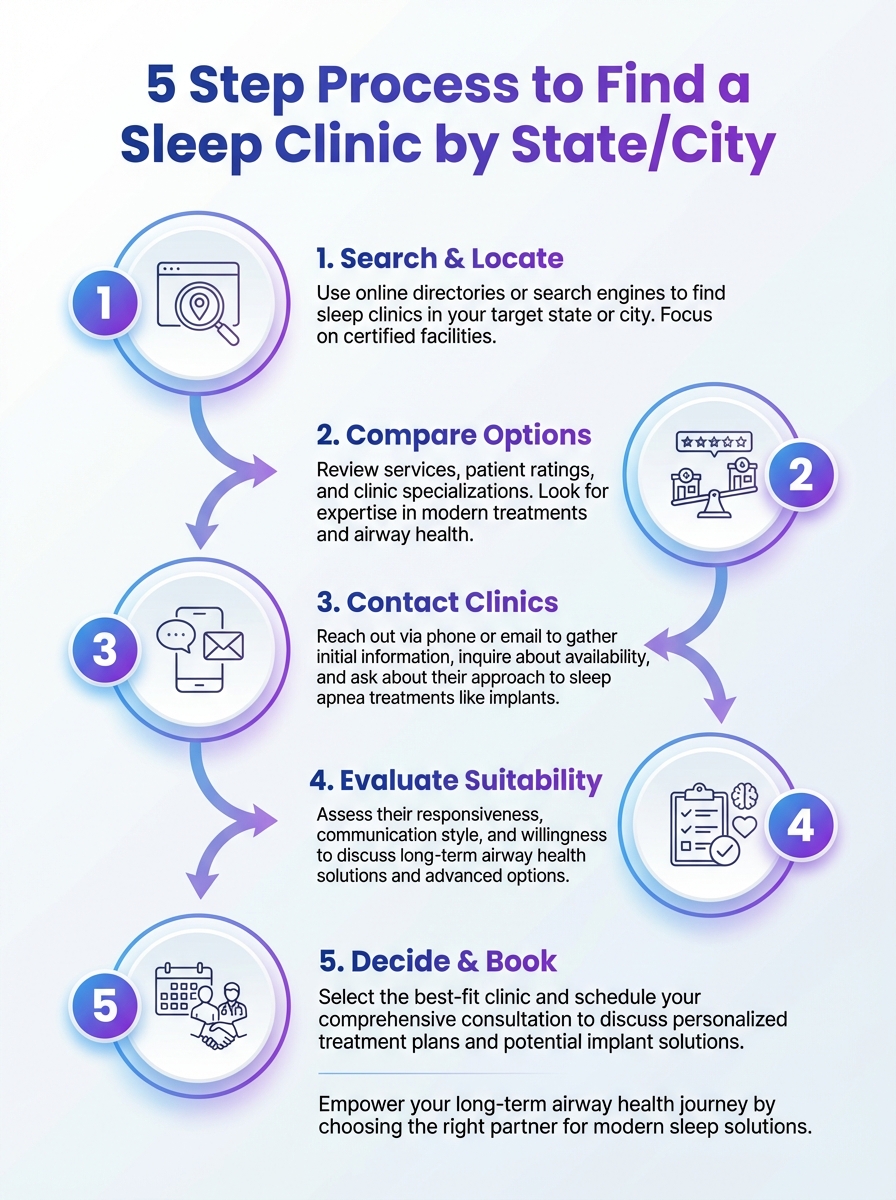
When people ask how to buy a modern sleep apnea implant, they are usually asking two things. First, how to access a specialist who can offer it, and second, how much of the cost insurance will cover in 2026. These are not devices you order online, they are medical therapies that include evaluation, surgery, titration, and follow‑up. Our clinic directory at SleepClinics.info is designed to connect you with accredited centers that can guide you through that full pathway.This infographic outlines a 5-step method to locate a sleep clinic by state or city. It guides decisions about modern sleep apnea implants for long-term airway health.
Long-Term Airway Health: What The 5‑Year Data Tells Us
When you are considering an implant, you are not just buying a device for this year, you are investing in how you will breathe at night over the next decade. That is why we lean heavily on long‑term research when we advise patients. Five‑year follow‑up from upper airway stimulation trials shows durable improvements in both apnea severity and oxygen levels. Median AHI values remained in the single digits, and oxygen desaturation indices stayed low, indicating the airway remained more stable at night. Just as important, patients reported less daytime sleepiness and better functional outcomes, which means they not only breathed better but also felt better in daily life. Many also reported less snoring, which often restores bed‑partner sleep and relationship harmony. We still monitor for rare device‑related issues, lead performance, and comfort over time, but the durability data available in 2026 is reassuring for appropriate candidates.Did You Know?
After five years of Inspire upper airway stimulation, median AHI fell to about 6.2 events per hour and long-term sleepiness and quality-of-life scores remained meaningfully improved compared with baseline.
Step‑By‑Step: The 2026 Pathway To Getting A Sleep Apnea Implant
Buying an implant in 2026 is really a structured care pathway. We walk patients through each stage so there are no surprises.- Confirm the diagnosis. You need a recent sleep study that documents obstructive sleep apnea and measures your apnea‑hypopnea index accurately.
- Demonstrate CPAP intolerance or failure. Insurers and surgeons expect a documented attempt at CPAP before moving to implants.
- Comprehensive sleep and medical evaluation. A sleep physician reviews your history, medications, anatomy, and overall cardiovascular risk.
- Drug‑induced sleep endoscopy. Under light anesthesia, the surgeon observes your airway to see if the collapse pattern is suitable for nerve stimulation.
- Shared decision‑making visit. We discuss device options, potential benefits, side effects, and costs so you can make an informed choice.
- Surgery and activation. After implantation and healing, the device is activated and adjusted, then fine‑tuned during follow‑up sleep studies.
Finding A Clinic Near You That Offers Implant Evaluation
Many patients tell us that the hardest part is knowing where to go. In 2026, implant programs are clustered in larger metro areas, but referral networks are growing rapidly. Our role with SleepClinics.info is to make that search less stressful. You can browse accredited centers by state, then drill down to specific cities that are most likely to offer implant counseling and surgery. For example, if you live in California, you might start with statewide options and then look specifically at major hubs. Patients often begin their journey using pages like:- Sleep Clinics in the San Francisco Bay Area for Northern California access.
- Sleep Clinics in San Diego for Southern California options outside Los Angeles.
City‑Level Access: Los Angeles, Miami, Houston, New York City, And More
Living in or near a large city can make getting an implant evaluation simpler. Many major metro areas now host multidisciplinary sleep centers that include sleep physicians, ENT surgeons, and cardiology support. If you are in Southern California, you can explore accredited clinics using Sleep Clinics in Los Angeles or Sleep Clinics in Sacramento depending on your location. These centers frequently partner with implant manufacturers and can guide you through candidacy assessment. On the Gulf Coast and in Texas, many patients start in large urban hubs. You can look for comprehensive sleep programs via Sleep Clinics in Miami and Sleep Clinics in Houston to find clinics familiar with both CPAP alternatives and surgical options. In the Northeast, New York state offers multiple options. Patients in and around the metro area often browse Sleep Clinics in New York City, while those further west use Sleep Clinics in Rochester or Sleep Clinics in Buffalo to find care closer to home.Implants vs CPAP: Adherence, Comfort, And Real‑World Usage
One of the strongest arguments for modern implants is not only how well they work in a lab, but how consistently people actually use them. CPAP can be very effective, but many patients struggle to wear it enough hours per night for long-term health protection. In implant studies, nightly usage rates are strikingly high. At 12 months, around 86% of patients were using their Inspire device nightly, and more than 90% used it at least five nights per week, which supports durable symptom control. Comfort is another key difference. There is no mask pressing on your face or hose to tangle in, which often makes therapy more acceptable for people who feel claustrophobic with CPAP. We still take adherence seriously with implants, because you control the device each night. During follow‑up, we review data from your system, troubleshoot any discomfort, and coach you on building a consistent bedtime routine around it.Did You Know?
In long-term Inspire follow-up, about 80% of patients reported using their implant therapy every night and experienced roughly a 45% improvement in daytime sleepiness along with better daily functioning.
Benefits You Can Expect: Beyond Just Lower AHI Numbers
We always care about your apnea‑hypopnea index and oxygen levels, but numbers are only part of the story. When we talk about long-term airway health in 2026, we are also talking about how you feel and function during the day. Patients with successful implants commonly report fewer awakenings and less gasping at night, which allows more continuous deep and REM sleep. That often translates into more stable mood, better focus, and fewer early morning headaches. Many report that their partners finally sleep through the night because snoring quiets down significantly. In five‑year data, up to 90% of bed partners described snoring as soft or absent, which can improve household wellbeing in very practical ways. Over time, consistent treatment can lower cardiovascular risk markers associated with untreated sleep apnea. While implants are not a cure for heart disease, they are an important part of protecting your heart and brain by stabilizing your nightly breathing.Risks, Limitations, And When Implants May Not Be Right For You
Even in 2026, sleep apnea implants are not a one‑size‑fits‑all solution. Being honest about limitations helps you make choices that feel safe and grounded. First, any surgery carries risks like infection, bleeding, pain, or device‑related discomfort. Serious complications are uncommon but can occur, which is why careful preoperative screening is so important. Second, some patients do not respond as strongly as others. In large registries, about 70% of patients meet strict responder criteria by 12 months, which means roughly 30% get partial benefit or need further adjustments. Third, certain patterns of airway collapse, very high body mass index, or complex medical conditions may mean implants are not the safest or most effective option. In those cases, we focus on optimizing other therapies such as positional therapy, oral appliances, weight management, or revisiting CPAP with newer interfaces. We encourage you to bring all of your questions and concerns to your consultation. There is no “wrong” question when you are considering a device that will live with you long term.Costs, Insurance Coverage, And Financial Planning In 2026
From the patient perspective, buying a modern implant is also a financial decision. The list price of device plus surgery can be significant, but many commercial insurers and Medicare plans cover these therapies for eligible patients in 2026. Your out‑of‑pocket costs depend on your specific plan, deductibles, and whether your clinic and surgeon are in‑network. Before scheduling surgery, we typically help you obtain a preauthorization that outlines expected coverage. It is important to factor in the long-term nature of the therapy. With high adherence and sustained benefit, implants can reduce emergency visits, cardiovascular complications, and work‑day loss related to severe sleepiness. We always recommend a detailed conversation with your sleep clinic’s billing team. They can walk you through expected charges for evaluation, surgery, device, follow‑up sleep studies, and remote monitoring so you can plan ahead.Questions To Ask Your Sleep Specialist Before You Commit
When you sit down with a sleep specialist or surgeon about implants, it helps to have a focused list of questions. We see our role as partners in that decision, not salespeople. You might ask:- Am I a good candidate for upper airway stimulation or other implantable options based on my sleep study and airway anatomy?
- What are the realistic benefits I can expect in terms of AHI reduction, snoring, and daytime symptoms?
- What are the specific risks for someone with my health history?
- How often will I need in‑person visits and sleep studies after implantation?
- What is my estimated out‑of‑pocket cost with my current insurance plan?
- How many of these procedures have you and your team performed, and what outcomes have you seen?