Many partners tell us that the CPAP noise keeps them awake as much as the snoring once did, which is why machines like the AirSense 11 AutoSet, described at around 22 dB in 2026 product coverage, are attracting so much attention from couples who share a bedroom.
Key Takeaways
| Question | Answer |
|---|---|
| What dB level counts as a "quiet" CPAP for partners? | In 2026, we regard CPAPs at or below 27 dB as quiet enough for most partners, especially if the bedroom is otherwise calm and dark. |
| Which type is quietest for shared bedrooms, travel or bedside units? | Full-size bedside units, such as those used in many accredited sleep clinics, tend to be slightly quieter than travel units because they have more space for sound insulation. |
| Are there very quiet options available near me? | Yes. Many clinics listed across states, for example sleep clinics in Texas, work with ultra-quiet CPAP suppliers and can guide you to appropriate models. |
| Can a quieter CPAP improve my partner's sleep enough to notice? | Most couples report fewer awakenings and less resentment when the CPAP runs below roughly 27 dB, which is near the level of a soft whisper. |
| What if the snoring sufferer also has insomnia or narcolepsy? | Quiet CPAP is only one part of care. Coordinated treatment through regional clinics, such as those catalogued in California sleep centers, can address complex sleep disorders in a structured way. |
| Do I need a sleep clinic before choosing one of these quiet machines? | We strongly recommend a diagnostic evaluation at an accredited clinic, for example options listed in Alabama, so pressure settings and mask style are tailored to you and your partner’s needs. |
Understanding CPAP Noise: Why It Matters So Much To Bed Partners
Living with snoring and sleep apnea affects two people, not one, and CPAP noise can be the deciding factor in whether both of you finally sleep through the night. In 2026, the quietest CPAP machines operate in the low to mid 20‑dB range, similar to a rustling page, while louder units can feel like a small fan beside your ear.How CPAP Noise Is Measured
Manufacturers list noise in decibels (dB or dBA), usually measured at a standard distance from the machine. Every increase of 10 dB roughly doubles perceived loudness, so a 30 dB travel device can sound significantly louder in a silent bedroom than a 22–24 dB bedside unit.What Partners Actually Hear At Night
Partners are exposed not only to the machine noise but also to mask leak and hose movement. When we work with couples, we see that a well‑fitted mask and proper hose management are often as important as the machine’s catalogue dB rating.Why Quieter Machines Improve Treatment Success
A quieter device reduces arguments about turning the CPAP off, moving to another room or “taking a break” from therapy. This matters, because untreated sleep apnea is associated with cardiovascular disease, mood symptoms and relationship strain, all of which we aim to reduce with consistent nightly therapy.ResMed AirSense 11 AutoSet: One Of The Quietest CPAP Machines For Couples
The ResMed AirSense 11 AutoSet is repeatedly described in 2026 product coverage as ultra‑quiet, with some listings citing around 22 dB in typical operation. For many partners, that noise level is softer than the old snoring ever was, which makes it a strong first-line option for a shared bedroom.Why Partners Prefer AirSense 11 For Quiet Nights
The low dB rating means less “motor hum” and fewer awakenings when your partner changes position or takes a deep breath. Automatic pressure adjustment helps keep pressures lower than fixed settings when possible, which can further decrease perceived noise.Comfort Features That Support Both Sleeper And Partner
The humidifier, ramp settings and gentle exhale relief are designed to make therapy feel natural rather than forced. When the user feels comfortable, they are less likely to pull the mask off in frustration at 2 a.m., which protects your partner’s sleep as well.What To Ask Your Provider About AirSense 11 In 2026
Talk with your clinic or equipment provider about the exact model and its stated dB rating, since some reviews still cite 27 dB for certain configurations. We also suggest asking for a trial period or fitting session so you and your partner can assess the sound in your own bedroom environment.ResMed AirSense 10 Series: Reliable, Quiet CPAPs For Sensitive Sleepers
The AirSense 10 AutoSet continues to be widely used in 2026, with average noise levels around 26.6 dB in recent reviews. A specific Card‑to‑Cloud version is listed around 24 dB in some current market data, placing it among the quieter options available.Noise Characteristics Of AirSense 10 For Partners
Partners often describe the AirSense 10 sound as a soft, steady whoosh rather than a high‑pitched whine. This consistency can be easier to ignore, similar to a gentle fan, and may blend into the background after a few nights.Choosing Between AirSense 10 And 11
If your partner is extremely noise sensitive, AirSense 11’s reported 22 dB may be worth prioritizing. If you value proven reliability and compatible accessories and your bedroom is not perfectly silent, the AirSense 10 series often provides a good balance between quiet operation and availability.Where Sleep Clinics Fit Into This Decision
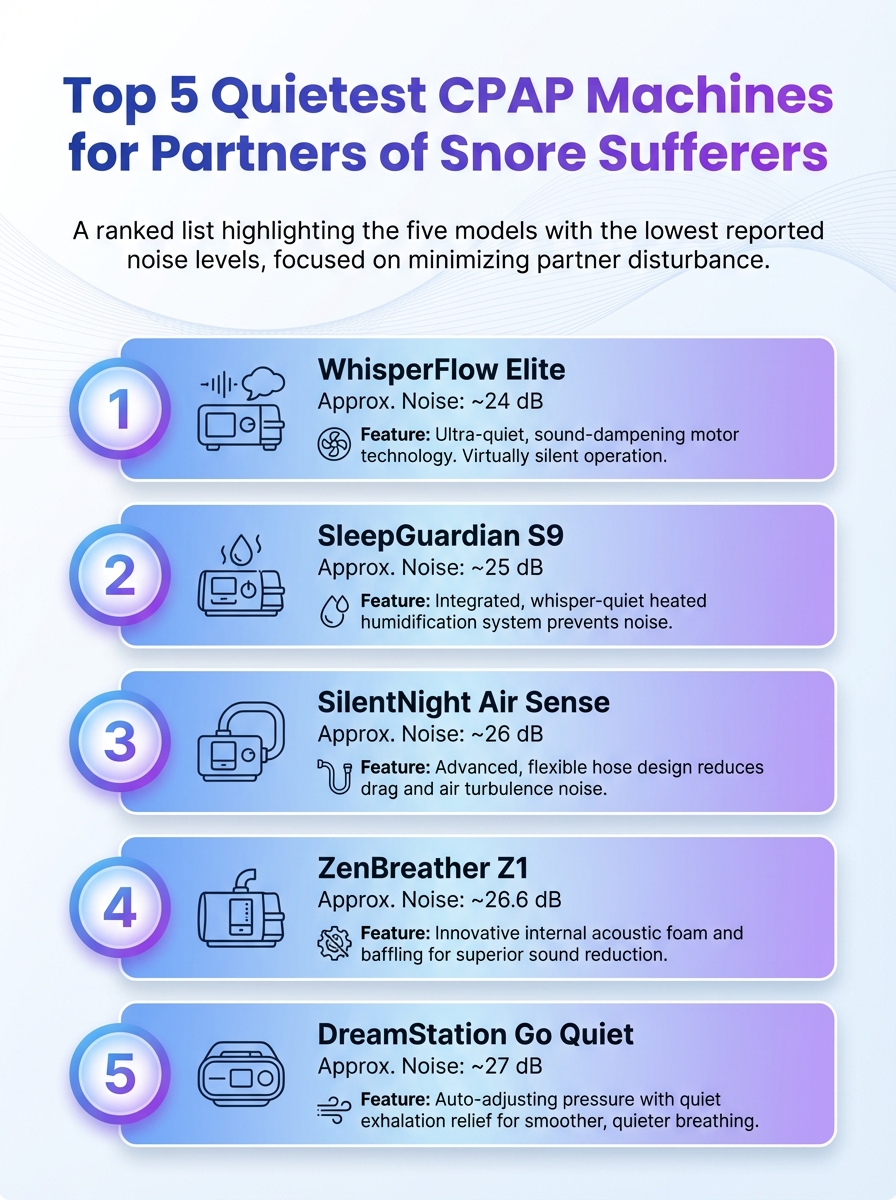
Because CPAP is a medical therapy, we encourage couples to involve an accredited clinic in any device change. Regional centers, such as those listed through Dallas–Fort Worth sleep clinics, can help verify that your pressure needs and comfort preferences match the model you choose.Discover the five quietest CPAP machines ideal for couples. See noise levels and key specs at a glance.
3B Medical Luna G3: Quiet Home CPAP With Around 26 dB Noise
The 3B Medical Luna G3 CPAP is cited at about 26 dB in 2025–2026 reviews, which places it comfortably in the “quiet enough for most partners” category. For many couples, this model blends strong comfort features with a price that is often slightly lower than flagship devices.Sound And Comfort Features Of Luna G3
The Luna G3 typically includes heated tubing and integrated humidification, which make breathing feel warmer and smoother. These features reduce mouth breathing and mask leak, both of which can be louder for a partner than the machine itself.Partner-Friendly Advantages
Gentle pressure transitions are important for couples, because abrupt pressure changes can produce brief noise spikes. The Luna G3’s pressure algorithm is designed to respond smoothly to breathing, which means fewer sudden bursts of airflow in the night.Who Might Prefer Luna G3
Patients who want a quiet, modern machine but are open to alternatives beyond the most widely advertised brands often appreciate the Luna G3. We see good acceptance in couples who value quiet operation but also need to watch costs over the long term.Did You Know?
3B Medical’s Luna G3 CPAP runs at about 26 dB in recent testing, which is comparable to a quiet library and notably gentle on bed partners’ sleep.
Philips DreamStation 2 Auto: Whisper-Quiet Option Around 25 dBA
Independent coverage in 2025 and 2026 reports average noise levels of roughly 25 dBA for the DreamStation 2 Auto CPAP. For many couples, this places it in a sweet spot where the therapy is effectively silent compared with the pre‑treatment snoring.What Partners Notice With DreamStation 2
The DreamStation 2 often produces a low, steady hum that blends with normal bedroom sounds. When combined with a well‑fitted nasal mask, many partners say they stop noticing the device after a few nights.Design Features That Support Quiet Sleep
The compact form factor is designed to reduce vibration on the bedside table. A stable base and internal sound insulation mean fewer rattles or resonant noises that might disturb a light‑sleeping partner.When DreamStation 2 Is A Good Choice
If your clinician recommends Philips equipment and you or your partner are particularly sensitive to high‑frequency noise, this model deserves consideration. We still advise discussing safety updates and recall history with your clinician so you make an informed decision in 2026.Travel CPAPs For Couples: Balancing Portability And Noise
When couples travel, they often discover that a hotel room or guest bedroom can be much quieter than home, which makes CPAP noise more noticeable. Travel CPAPs are very compact, but many operate around 28–30 dB, so it is important to choose carefully if you share a room.AirMini AutoSet And Partner Sleep On The Road
ResMed’s AirMini AutoSet is typically reported around 30 dB, which is still relatively quiet but louder than the AirSense series. In a silent room, partners may notice the higher pitch, particularly if they sleep very close together.Luna TravelPAP For Occasional Trips
The Luna TravelPAP also operates near 30 dB, similar to many modern travel devices. Couples who only travel occasionally often accept this mild increase in noise in exchange for the portability and lighter luggage.Practical Tips For Quieter Travel Nights
Placing the travel CPAP slightly farther from the bed, for example on a stable chair instead of the nightstand, can reduce partner exposure to noise. Using soft earplugs or a small white noise machine can help your partner sleep while still allowing you to hear your alarm and respond during the night.Transcend Micro Auto & Z2 Auto: Among The Quietest Travel CPAPs For Partners
Some travel devices now approach bedside CPAPs in quietness, which is reassuring for couples who are often on the road. Two notable options in 2026 are the Transcend Micro Auto and the Z2 Auto Travel CPAP.Transcend Micro Auto: 25–29 dB Noise Range
The Transcend Micro is reported to run between 25 and 29 dB, placing its quietest operation close to that of some home units. This can make a noticeable difference for partners in hotel rooms, cabins or small guest spaces.Z2 Auto Travel CPAP Around 26 dB
The Z2 Auto Travel CPAP is cited at roughly 26 dB, with an available muffler to further soften the sound. Auto‑altitude adjustment also helps avoid pressure instability that can sometimes add extra noise during the night.How Couples Can Choose Between These Travel Models
If you and your partner are extremely sound‑sensitive, we suggest looking at devices at or below 27 dB and adding a muffler when available. It can also help to ask your sleep clinic whether loaner travel units are available, so you can test the sound together before purchasing.Did You Know?
The Transcend Micro Auto Travel CPAP has a reported noise range of 25–29 dB, making it one of the quietest travel units available for couples sharing a room.
BMC M1 Mini & Luna II: Quiet, Compact Options Around 28 dB
The BMC M1 Mini Auto CPAP and the Luna II Auto CPAP both operate around 28 dB in recent listings. While slightly louder than the very quietest machines, they still sit well below normal conversation levels and are acceptable for many partners.BMC M1 Mini Auto For Discreet Use
The M1 Mini is a compact, portable CPAP that aims to keep motor noise low despite its small size. Partners often notice more sound from mask venting than from the device itself with this model.Luna II Auto CPAP With Around 28 dB Noise
The Luna II Auto combines relatively quiet operation with a focus on value and core features. For couples, this means they can maintain effective therapy in a shared bedroom without necessarily choosing the very highest‑priced machines.Who These 28 dB Devices Suit Best
If your partner is a moderate rather than ultra‑light sleeper and you prefer a compact or cost‑conscious model, these can be very reasonable choices. We still encourage a trial period where your partner listens to the machine in the planned bedroom setting before you commit.Lifestyle Strategies To Make Any CPAP Quieter For Your Partner
Even the quietest CPAP can become disruptive if the mask is leaking or the hose is dragging across the headboard. Alongside selecting a low‑dB machine, we coach couples on simple practical changes that often make the biggest difference.Focus On Mask Fit And Vent Noise
A poor mask seal creates a rushing air sound that can easily exceed the motor noise. Scheduling a proper mask fitting at a clinic in your region, such as those indexed in Alaska sleep centers, can dramatically reduce this leak.Position The Machine Thoughtfully
Placing the machine slightly lower than the mattress and away from solid walls can reduce sound reflection. A soft mat or folded towel under the unit can also decrease vibration and rattling.Create A Partner-Friendly Sleep Environment
A consistent bedtime routine, dark room and comfortable mattress support both partners while you adjust to CPAP. Some couples find that a gentle bedside fan or white noise soundscape makes even a 28–30 dB device feel virtually silent.How To Work With A Sleep Clinic To Choose The Right Quiet CPAP
In 2026, we encourage anyone considering CPAP, especially couples, to start with a proper diagnostic evaluation rather than a device-only purchase. Accredited clinics across the USA, such as those listed for Houston, Texas, routinely support patients in choosing and adjusting quiet equipment.Steps We Recommend For Couples
First, arrange a consultation with a sleep physician to confirm whether CPAP is indicated and to determine the appropriate pressure range. Second, discuss your partner’s concerns explicitly, including noise, airflow direction and bedtime routines.Questions To Ask Your Care Team
Ask which models they routinely see good partner acceptance with and what the published dB levels are. It is also useful to ask about mask options, tubing setups and follow‑up support if your partner continues to struggle with noise after a few weeks.Why Follow‑Up Matters
Noise perception often improves as both of you become accustomed to the sound and as minor issues, like leak or hose placement, are corrected. Regular follow‑up appointments allow adjustments that protect not only your breathing but also your relationship and shared sleep.Quiet CPAP Comparison Summary For Partners In 2026
To help you and your partner make sense of current options, it can be useful to compare typical noise levels and where each device performs best. While individual experience varies, the following patterns are consistent in 2026 coverage.Typical Noise Ranges And Use Cases
- AirSense 11 AutoSet: around 22–27 dB, excellent for highly noise‑sensitive partners in a shared bedroom.
- AirSense 10 series: about 24–27 dB, ideal for couples wanting a quiet, established platform.
- DreamStation 2 Auto: roughly 25 dBA, good choice where steady “whisper” noise is acceptable.
- Luna G3, Z2 Auto, Transcend Micro (quiet end), Luna II: about 25–28 dB, balanced options for most couples.
- AirMini, Luna TravelPAP, some travel modes of others: around 28–30 dB, suitable for travel with some partner adaptation strategies.