Pediatric obstructive sleep apnea now affects an estimated 1–4% of children, yet parents in 2026 face an increasingly complex landscape of testing options, accreditation labels, and facility types when they try to find top rated pediatric sleep apnea testing centers.
As of 2026, more than 2,300 AASM‑accredited sleep centers operate across the United States, so the challenge is no longer basic availability but identifying which facilities are genuinely optimized for children and which are better suited to adults.
Key Takeaways
| Question | Answer (2026 Insight) |
|---|---|
| What defines a “top rated” pediatric sleep apnea testing facility? | In 2026, the strongest indicators are AASM accreditation, pediatric-trained staff, child‑specific protocols, and strong outcome tracking. You can start by browsing regional clinic directories such as Los Angeles sleep clinics to shortlist accredited labs, then drill into which ones explicitly serve children. |
| How can I quickly locate pediatric‑friendly sleep labs in my state? | We recommend starting with regional listings, for example Orlando sleep clinics or New York City sleep clinics, then cross‑checking clinic names for terms like “Children’s,” “Pediatric,” or “Children’s Hospital.” |
| Do top facilities always require an in‑lab overnight study? | Not always. While polysomnography remains the gold standard, leading centers increasingly evaluate home sleep apnea testing (HSAT) and other triage tools. Articles like what to expect from a sleep study help families understand both in‑lab and home workflows. |
| Which cities have strong clusters of pediatric sleep centers? | Major metros like Los Angeles, the San Francisco Bay Area, Orlando, Tampa Bay, Atlanta, Birmingham, Montgomery, and New York City host multiple accredited clinics, as cataloged on our sleep clinic resources hub, giving families multiple options within a regional drive. |
| How often do children need repeat sleep apnea testing? | Because up to 40% of children may have persistent OSA after adenotonsillectomy, top facilities routinely schedule follow‑up studies when symptoms remain, especially for high‑risk children. |
| Where can I learn more about pediatric sleep apnea risks? | We break down signs, risks, and treatment pathways in detail in our educational content, including understanding sleep apnea signs, risks, and treatment, so parents can ask informed questions when choosing a facility. |
| How do I evaluate clinical quality beyond ratings and reviews? | We advise looking at accreditation, pediatric expertise, diagnostic technology, and care coordination, then using regional directories like our sleep clinics blog as a starting point rather than the final word. |
1. Why Pediatric Sleep Apnea Testing Requires Specialized Facilities
Pediatric sleep apnea is not just a smaller version of adult sleep apnea, and facilities that treat it effectively in 2026 operate with very different assumptions, protocols, and safeguards. Children have unique anatomy, developmental trajectories, and behavioral patterns, so a lab optimized for adult obstructive sleep apnea may miss subtle pediatric respiratory events or misinterpret normal sleep architecture for age.Key differences between adult and pediatric sleep labs
Top rated pediatric sleep apnea testing facilities adjust nearly every stage of the workflow for children. This starts with child‑size sensors and cannulas, age‑specific scoring rules, and monitoring for comorbidities like ADHD, craniofacial anomalies, and neuromuscular conditions that alter respiratory control.- Child‑appropriate room design and caregiver sleeping accommodations
- Pediatric‑trained technicians and physicians
- Protocols for toddlers, school‑age children, and adolescents
- Lower thresholds for clinically significant apnea‑hypopnea index (AHI)
Why accreditation matters more in 2026
As telemedicine and home testing equipment proliferate in 2026, parents frequently encounter loosely supervised or minimally validated “sleep tests.” AASM accreditation helps filter noise by attesting that a sleep program meets standardized requirements for staffing, calibration, and scoring, which is critical when evaluating respiratory events in small children.2. Core Criteria That Define “Top Rated” Pediatric Sleep Testing Centers
When we evaluate pediatric sleep apnea facilities in 2026, ratings and online reviews are only one signal in a bigger quality model. We look at structural, process, and outcome measures that together predict whether a center can reliably evaluate a child with suspected obstructive sleep apnea.Structural criteria
These are the relatively static attributes of a facility that parents can verify before scheduling. They include accreditation, board‑certified sleep physicians, and access to pediatric subspecialists such as ENT, pulmonology, and craniofacial teams.- AASM accreditation as a sleep center or sleep disorders program
- Board‑certified sleep medicine physicians familiar with pediatric scoring rules
- Integrated pediatric services for ENT, pulmonology, dentistry, and neurology
- Capability to monitor carbon dioxide in small children and infants
Process and outcome criteria
Process criteria describe how care is delivered, for example pre‑test triage and parent education. Outcome criteria focus on post‑test accuracy, follow‑up testing rates, and improved daytime symptoms or behavior.| Category | What to look for in 2026 |
|---|---|
| Pre‑test screening | Use of validated pediatric questionnaires before ordering polysomnography |
| In‑lab protocols | Standardized sensor placement, video monitoring, and age‑adjusted scoring |
| Family experience | Pre‑visit walkthroughs, flexible scheduling, parent sleep space in the room |
| Clinical outcomes | Documented improvement in AHI, daytime symptoms, school performance when re‑evaluated |
3. How To Use Regional Directories To Locate Pediatric‑Friendly Labs
Families rarely search the entire national ecosystem; we see most start regionally and then refine their options. In 2026, curated regional directories like our city‑level pages provide efficient entry points for locating accredited labs near home.Leveraging city‑specific clinic listings
Our city pages catalog sleep clinics by geography, which is a convenient first filter. For example, the Birmingham, Alabama sleep clinics page lists 26 facilities, including the "Children's of Alabama Sleep Disorders Center," which explicitly signals pediatric expertise.- Use city pages to enumerate clinics within realistic driving distance.
- Scan headings for terms like “Children’s,” “Child,” or “Pediatric.”
- Cross‑check names with hospital websites for pediatric program details.
Examples of cities with notable pediatric listings
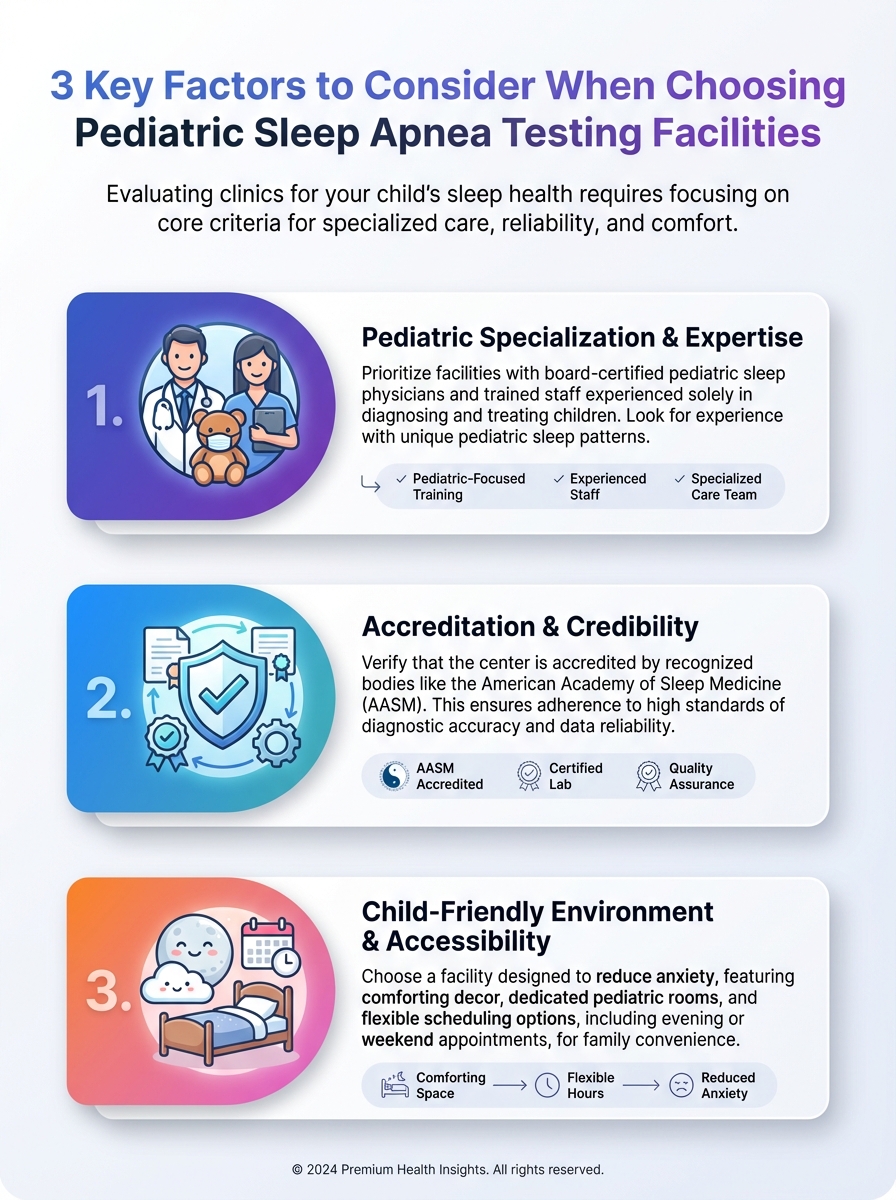
Several of our indexed cities stand out in 2026 for the number of clinics mentioning children in their names. Orlando lists "Nemours Children's Hospital Orlando Pediatric Sleep Center" and "Childrens Sleep Laboratory," while Tampa Bay includes "The Childrens Sleep Laboratory" and "Johns Hopkins All Children's Hospital Sleep Center."Three factors to evaluate when selecting pediatric sleep apnea testing facilities. This infographic helps families compare top-rated options.
From directory to decision
Once families identify a shortlist from directories, the next step is direct verification. We recommend calling each facility, confirming they routinely test children in your child’s age bracket, and asking about pediatric‑specific protocols.Did You Know?
Pediatric sleep questionnaires now show sensitivity ranging from 73% to 96% for detecting sleep-disordered breathing in children, which is why top facilities rely on them to prioritize who needs full overnight testing.
4. Examples of Top Rated Pediatric Sleep Apnea Testing Facilities in Major Metros
We do not rate individual centers, but we can highlight facilities and regions where pediatric sleep capability is explicitly visible in 2026. These examples illustrate how families can interpret naming patterns and hospital affiliations to infer pediatric orientation.Los Angeles and Southern California
Our Los Angeles sleep clinics listing shows a high concentration of academic and children’s hospitals. Notable pediatric‑aligned names include "Children's Hospital Los Angeles Sleep Center," "CHOC Children's Sleep Center," and "CHOC Children's At Mission Hospital Sleep Center," all embedded within large pediatric systems.- Children's Hospital Los Angeles Sleep Center (pediatric focus, tertiary care environment)
- CHOC Children’s Sleep Center (child‑only hospital network)
- UCLA Sleep Disorders Center and Olive View‑UCLA (academic infrastructure, subspecialty access)
5. Regional Snapshots: Southeast Clinics With Pediatric Capacity
In the Southeast, our directories show numerous mixed‑age sleep labs where pediatric testing is part of a broader program. Parents in 2026 typically look for explicit “Children’s” branding or confirm pediatric experience by phone.Birmingham and Montgomery, Alabama
The Birmingham listing identifies "Children's of Alabama Sleep Disorders Center," likely integrated with a pediatric hospital infrastructure. Nearby entries such as "UAB Medicine Sleep Center" and "St. Vincent's Sleep Disorders Center" often participate in pediatric care although names do not explicitly say “children.” Similarly, the Montgomery sleep clinics page lists mixed facilities like "Baptist Medical Center South Sleep Disorders Center" and "University Sleep Disorders Center," which may host pediatric testing sessions depending on staffing.Orlando and Tampa Bay, Florida
Our Orlando clinics and Tampa Bay clinics pages surface multiple child‑branded labs. These include "Nemours Children's Hospital Orlando Pediatric Sleep Center," "Childrens Sleep Laboratory," "The Childrens Sleep Laboratory," and "Johns Hopkins All Children's Hospital Sleep Center," which are typical of top rated pediatric‑centric environments.- Ask whether technicians exclusively or primarily work with children.
- Confirm caregiver sleep accommodations during overnight studies.
- Verify coordination with pediatric ENT if surgery is under consideration.
6. Northeast and Bay Area: Academic Pediatric Sleep Programs
In 2026, some of the most advanced pediatric sleep testing programs are embedded within major academic centers. Our directories capture several such clusters, especially in the San Francisco Bay Area and New York City.San Francisco Bay Area
The San Francisco Bay Area clinics page highlights "Stanford Children's Health Sleep Center," which represents a classic example of a tertiary pediatric program. These centers often integrate research protocols, complex case management, and coordinated ENT, craniofacial, and pulmonology care.New York City region
The New York City sleep clinics listing includes a dense set of academic facilities. "Weill Cornell Pediatric Sleep and Breathing Disorders Center" appears explicitly pediatric, while programs at Mount Sinai, NYU Langone, and Northwell Health frequently include pediatric tracks even if the word “pediatric” is not in the clinic title.When evaluating academic centers, we suggest asking about fellowship training, research in pediatric OSA, and whether your child may benefit from participation in ongoing clinical trials on home testing or algorithm‑enhanced monitoring.
7. Technology And Protocols Used By Leading Pediatric Sleep Labs in 2026
Top rated pediatric sleep apnea testing facilities in 2026 share common core technologies, but they diverge on how aggressively they adopt newer tools for triage and monitoring. Families who ask targeted questions about equipment and protocols gain a clearer picture of the facility's sophistication.Gold standard: In‑lab polysomnography
Despite rapid innovation, overnight in‑lab polysomnography remains the reference standard in 2026 for diagnosing pediatric OSA. These studies record EEG, EOG, EMG, ECG, airflow, respiratory effort, oxygen saturation, and often transcutaneous or end‑tidal CO₂, with video monitoring for behavioral events.Screening tools and algorithm‑enhanced monitoring
Validated questionnaires are widely used for initial screening before ordering PSG. In parallel, algorithm‑enhanced oximetry and portable monitors are being evaluated for high‑yield triage, with reported diagnostic accuracies that make them attractive for resource‑constrained systems.- Questionnaires to estimate risk of sleep‑disordered breathing before PSG
- High‑resolution oximetry with automated pattern detection
- Home sleep apnea testing protocols under evaluation for selected age groups
Did You Know?
There are 5,900 board-certified sleep medicine physicians in the United States, providing a substantial specialist workforce to staff top-rated pediatric sleep apnea testing centers.
8. Home Sleep Apnea Testing (HSAT) For Children: Where Top Facilities Stand
Parents often ask us whether home sleep apnea testing can replace in‑lab studies for children. In 2026, the short answer is that HSAT remains investigational for pediatrics, and top rated facilities use it cautiously, if at all, outside of clinical trials.Research trajectory for pediatric HSAT
A major randomized trial is underway to compare HSAT with in‑lab polysomnography for children aged 5–12, enrolling several hundred participants. Many leading centers participate or monitor this research closely to determine how HSAT could safely expand capacity for lower‑risk children.Practical implications for families
Until high‑quality data mature, top pediatric programs typically reserve HSAT for very specific scenarios. For example, they may use portable monitoring when in‑lab studies are logistically impossible or as an adjunct for postoperative surveillance rather than initial diagnosis.- Expect top centers to still recommend in‑lab PSG for definitive diagnosis in 2026.
- Be cautious about direct‑to‑consumer HSAT offerings that lack pediatric validation.
- Ask whether HSAT, if offered, is part of a structured research or quality‑assurance program.
9. Questions Parents Should Ask Any Pediatric Sleep Apnea Testing Facility
From our perspective, the most effective parents in 2026 approach facility selection like a technical evaluation. They ask targeted questions about staffing, protocols, and follow‑up workflows rather than relying solely on star ratings.Clinical capability questions
These questions probe the core expertise of the program. They help distinguish a true pediatric center from an adult‑oriented lab that occasionally accepts children.- How many pediatric sleep studies do you perform per month, and in which age ranges?
- Are your interpreting physicians board‑certified in sleep medicine with pediatric training?
- Do you follow pediatric‑specific AHI thresholds and scoring rules?
Experience and logistics questions
These focus on what the night in the lab will look like for your child and you. They often reveal how much the facility has invested in making the environment tolerable for anxious children.- Can a parent stay in the room overnight, and is a bed or recliner provided?
- What is your approach for children with autism, ADHD, or sensory sensitivities?
- How quickly will we receive results, and how will they be explained to us?
We recommend writing these questions down and treating the scheduling call as a mini‑interview. Top facilities welcome this level of scrutiny because it aligns with their own quality metrics.
10. Interpreting “Top Rated” Beyond Online Reviews in 2026
Online reviews remain noisy signals, especially for technical services like sleep labs where patients may not fully understand the diagnostic value of the test. Top rated pediatric facilities in 2026 distinguish themselves less by average star rating and more by institutional quality markers.Institutional quality markers
These markers are difficult for low‑quality providers to fake, because they require sustained investment and external oversight. Parents can often confirm them via public websites or a single phone call.- AASM accreditation status and duration
- Affiliation with a children’s hospital or major academic health system
- Participation in research, clinical trials, or quality‑improvement collaboratives
- Dedicated pediatric sleep webpages or program descriptions